










































No products in the cart.






Institut Teknologi Sepuluh Nopember(Source: Fadhila Nurhakim/unplash.com)
Semarang– Indonesia’s public higher education system continues to face a growing gap between the number of applicants and the limited number of available seats, highlighting deeper structural challenges in access and capacity.
Each year, hundreds of thousands of high school graduates compete for admission through the national selection system SNPMB (Seleksi Nasional Penerimaan Mahasiswa Baru), yet the available quotas remain significantly lower than the demand.
There are three main admission pathways for state universities: SNBP, SNBT, and independent selection. SNBP is a pathway based on students’ academic records and achievements during high school, while SNBT is a standardized test named UTBK. Meanwhile, independent selection is conducted directly by each university, often involving written tests or specific criteria determined by the institution.
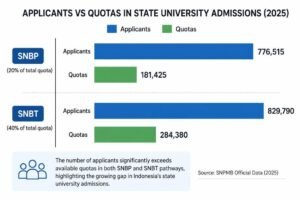
Despite these multiple pathways, the gap between applicants and available quotas in state universities remains clearly visible. For example, the SNBP pathway allocates 20 percent of the total quota, amounting to 181,425 seats, consisting of 16,150 seats for diploma (D3) programs, 22,603 for applied bachelor (D4) programs, and 142,672 for undergraduate (S1) programs. According to official SNPMB data, the number of applicants reached 776,515.
Similarly, the SNBT pathway attracts the most applicants because of the largest admission quota, accounting for 40 percent of the total available seats.
According to official SNPMB data, the total quota for SNBT in 2025, including additional seats reallocated from unfilled SNBP quotas, reached 284,380 seats, consisting of 26,490 seats for diploma (D3) programs, 32,352 for applied bachelor (D4) programs, and 225,538 for undergraduate (S1) programs. Meanwhile, the number of participants who took the SNBT exam reached 829,790.
These figures clearly show a significant gap between the number of applicants and the available quotas, where hundreds of thousands of applicants are unable to secure a seat in state universities. This imbalance leads to intense competition, especially for popular majors.
This situation is directly experienced by Ilma, who participated in the SNBT 2025 selection process. She stated, “In my opinion, it is now very difficult to get accepted into state universities due to the high number of applicants, which makes the competition extremely tight, especially for popular majors.”
Dafa, who also participated in the SNBT 2025 selection process, expressed a similar view and added that the available quotas are actually sufficient, considering the need to maintain the quality of education in state universities.

However, there are underlying reasons behind this limitation. During a press conference live on the official SNPMB YouTube channel, the Chair of the SNPMB Steering Committee, Eduart Wolok, stated that the limited quotas at each university are determined based on the available infrastructure and academic staff capacity. He explained that this policy is necessary to ensure the quality and sustainability of higher education in Indonesia.
Syarat dan Ketentuan Penulisan di Siaran-Berita.com :
Setiap penulis setuju untuk bertanggung jawab atas berita, artikel, opini atau tulisan, foto, gambar, ilustrasi, apa pun yang mereka publikasikan di siaran-berita.com - Syarat dan Ketentuan - Kebijakan Privasi - Panduan Komunitas - Disclaimer








SERANG - Di dunia kerja, banyak perusahaan berlomba-lomba meningkatkan kualitas sumber daya manusia melalui pelatihan, seminar, dan pengembangan karier. Namun,...
Read moreDetails




Siaran-Berita.com adalah portal media berita online yang bersifat terbuka dan inklusif. Kami menyediakan wadah bagi masyarakat umum, penulis lepas, praktisi humas, hingga pengamat untuk berkontribusi dalam bentuk tulisan
Untuk memudahkan membaca berita terbaru di Siaran-berita.com segera download aplikasi khusus untuk Android di Google Play dan nikmati kemudahan membaca berita langsung dari gadget Anda